An Iranian drone was intercepted early Monday over the United Arab Emirates' territorial waters, the Defense Ministry said. The attack followed an exchange of fire between Iran and the United States over the weekend, which was the first significant military action in the war for more than a month.
Here’s a look at the latest developments in the Iran war and the wider Middle East. Full coverage can be found here.
Get The Latest News!
Don't miss our top stories and need-to-know news everyday in your inbox.
Iran fired a drone at the United Arab Emirates on Monday, which the UAE's Defense Ministry said was intercepted over its territorial waters.
After more than a month with no significant fighting, the U.S. attacked rocket launchers on an Iranian island on Sunday, saying they were preparing to launch mines into the Strait of Hormuz. Iran responded by launching missiles at U.S. sites in Jordan, all of which were intercepted.
Iranian President Masoud Pezeshkian said that his country wasn't seeking war, but that “we will respond decisively to aggressors." The UAE called the attack a “dangerous escalation” from Iran.
A tanker was struck by three unknown projectiles 17 nautical miles east of Khasab, Oman, the United Kingdom Maritime Trade Operations Center said late Monday.
The operations center said the tanker reported being struck while transiting out of the Strait of Hormuz. No casualties were reported and the MTOC said the incident was being investigated.
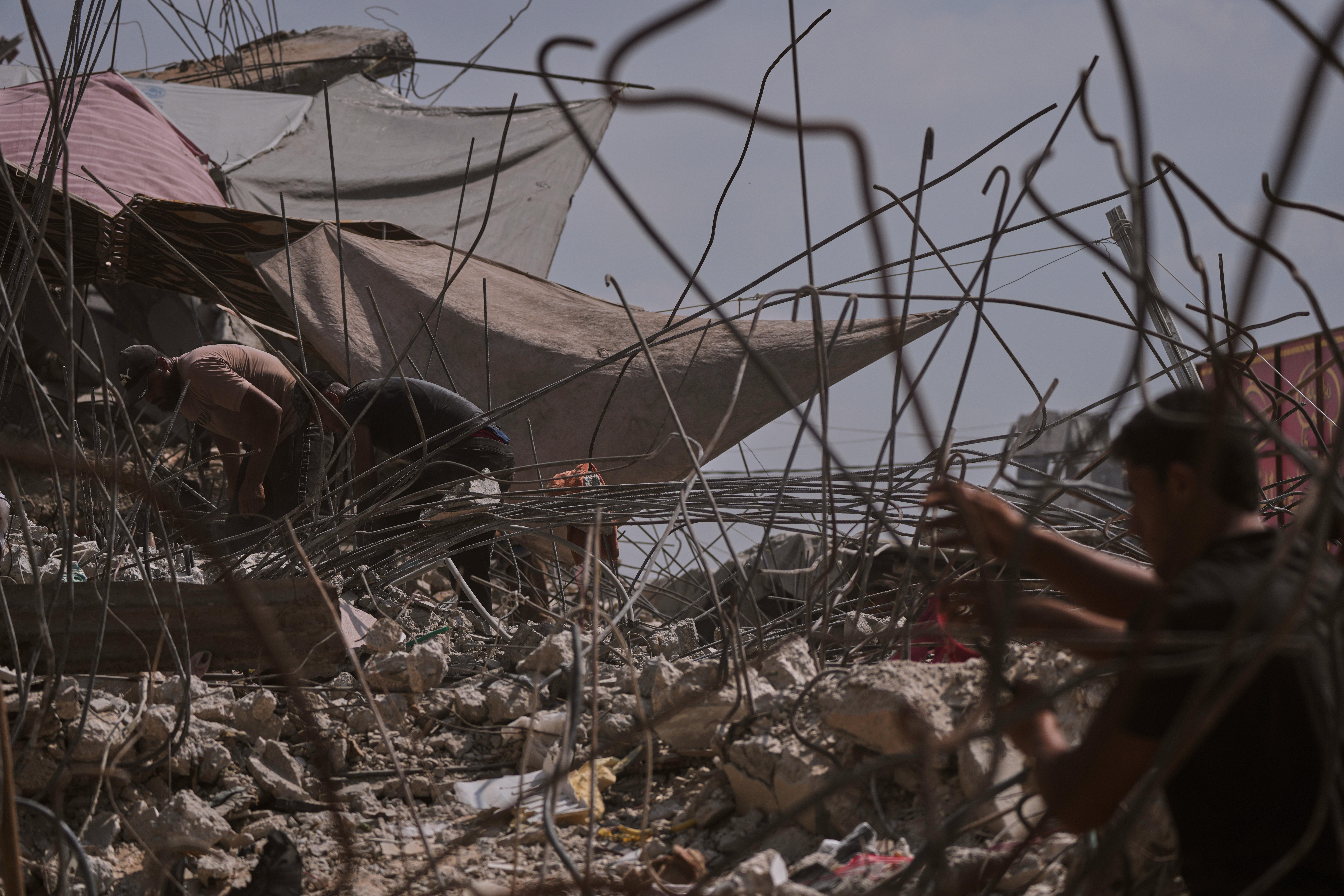
Israeli airstrikes on Monday killed at least five Palestinians in Gaza City, hospital officials said.
One strike hit the entrance of a residential building near the city’s municipal park, killing two, according to Shifa Hospital, which received the casualties. Two other Palestinians were critically wounded, the hospital said.
A second strike hit a vehicle in the city’s Tal al-Hawa neighborhood, killing three, the hospital said.
The deaths were the latest among Palestinians in Gaza since a ceasefire deal reached in October attempted to halt a more than two-year war between Israel and Hamas.
The leaders of China, Russia and India gathered with other heads of state in Kyrgyzstan on Monday for the summit of the Shanghai Cooperation Organization, a group billed as a counterweight to U.S. global influence.
The summit includes Chinese President Xi Jinping, Russian President Vladimir Putin and Indian Prime Minister Narendra Modi. Pezeshkian was scheduled to meet with Putin on the sidelines on Tuesday.
Meanwhile, U.S. Treasury Secretary Scott Bessent was set to host meetings of the Group of 20 finance ministers in North Carolina on Monday and Tuesday, as Washington pressures other countries to help economically isolate Iran.
The Trump administration approved the sale of multiple-purpose helicopters worth $800 million to the government of Iraq despite concerns that Iraqi authorities are not doing enough to clamp down on Iranian-affiliated militias.
The State Department said Monday it had given the green light for the sale of an unspecified number of Bell 412EPX and Bell 407M helicopters along with related equipment, including weaponry.
The choppers can be used for personnel and cargo transport but can also be converted into attack aircraft.
Israel signed a multibillion-dollar weapons deal with Greece on Monday, the largest between the two Mediterranean countries, as Israeli defense exports soar.
Israel’s Defense Ministry said the 3 billion-euro ($3.5 billion) defense export deal, dubbed Achilles Shield, is one of the country’s largest and includes a multilayered air defense system for Greece using Israeli technology.
The agreement comes as Israeli weapons exports have reached record highs with more than $19 billion last year, a 30% increase from 2024, according to official data. That is despite widespread criticism of Israel’s conduct in its wars in Gaza, with the Hezbollah militant group and with Iran.
Iraqi Prime Minister Ali al-Zaidi rejected a proposal to keep some forces from a U.S.-led coalition in Iraq after Sept. 30, when the mission is supposed to end, state media reported.
Government spokesperson Haider al-Aboudi told The Associated Press by phone that the U.S.-led coalition had offered to leave a number of its advisers in Iraq beyond Sept. 30 if the Iraqi government wanted them to remain.
U.S. troops pulled out of bases in most areas of Iraq last year but maintained a presence in the semiautonomous northern Kurdish region. The remaining troops are supposed to leave within the next month.
Countries are welcome to join the defense pact signed by Turkey, Pakistan and Saudi Arabia, Turkish Foreign Minister Hakan Fidan said Monday.
The three countries agreed to a defense alliance on Aug. 7 that would treat an attack on one as an attack on all. Fidan said the Mecca Defense Alliance would be willing to accept new members following the first meeting between high-level officials from the current member states.
Egypt has been touted as a potential member for the alliance of Muslim-majority states and Fidan promised close collaboration with “friendly countries.”
While the alliance is intended to reinforce collective defense in a way similar to NATO’s Article 5, members have stressed that it is not aimed against any specific foe.
Lebanese President Joseph Aoun is asking for Greece's help in implementing an agreement to end the war with Israel.
During meetings on Monday in Athens, Aoun told Greek President Constantine Tassoulas and Prime Minister Kyriakos Mitsotakis that Lebanon has been through long wars and “its people are tired.”
He suggested that Greece has good relations with both Lebanon and Israel, and could help facilitate an end to decades of war.
An Iraqi court sentenced a man to 15 years in prison after convicting him of taking part in the kidnapping of U.S. journalist Shelly Kittleson in Baghdad in March.
The Central Criminal Court in Baghdad sentenced Amir Rahim Jabbar Lazim under Iraq’s anti-terrorism law.
Kittleson, a freelance journalist based in Rome who works with several American and European media outlets, was kidnapped by the Kataib Hezbollah militia in Baghdad on March 31 and released after about a week in captivity.
U.S. Vice President JD Vance said President Donald Trump was “sending a message” with an AI video posted on social media over the weekend that featured a stylized imaginary attack on Iran’s Kharg Island, which is key to its oil exports and which Trump has repeatedly threatened.
Vance said that the president “would be the first to say he doesn’t make announcements about military actions on social media, but I think that he’s sending a message to the Iranians.”
Despite Vance's comment, Trump makes virtually all of his announcements on military action and most other matters on his social media account.