Many NFL players come from big-time college programs, like Ohio State, Notre Dame, and Alabama. But some come from a smaller stage, with dimmer lights.
Only two players from Division III, the lowest rung of NCAA football, are on NFL regular-season rosters this year.
Get The Latest News!
Don't miss our top stories and need-to-know news everyday in your inbox.
NFL scouts and executives frequently gloss over small programs, focusing on the powerhouse schools that create the buzz on Saturday afternoons.
Pat Coleman is the executive editor of d3football.com, the leading Internet source on Division III. He attributes the oversights to a perceived lack of competition.
“Many times, a GM is going to look at a Division III player’s tape or scouting report, and discard it due to the level of competition they face,” said Coleman. “No matter how they may have dominated at Division III, some NFL executives are going to think it wasn’t against better competition.”
From this area, receiver Jeff Query (Millikin) was one of the rare D-III players to be drafted, as he was picked in the fifth round in 1989 by Green Bay.
He led the Packers in punt returns in both 1989 and 1990, and was named the NFL’s Fastest Man in both of those seasons. Query later led Cincinnati in both receptions and receiving yards in 1993.
A half century before the advent of Division III in 1973, Millikin sent at least eight players to the NFL, including star lineman George Musso, who earned a spot in the Pro Football Hall of Fame in 1982.
Olindo Mare spent the 1991 season at MacMurray College, where he handled kicking duties and also averaged 36.7 yards per punt. He then spent time at two junior colleges before finally transferring to Syracuse.
Mare was in the NFL for sixteen seasons with five teams from 1997-2012, including ten with Miami, where he is the franchise’s career leader in field goals.
An NFL Pro Bowl pick in 1999, Mare is 27th on the all-time NFL career scoring list with 1,555 points.
Linebacker Nicholas Morrow (Greenville) appeared in 105 games, with 58 starts, for five teams from 2017-24. He started all 17 games for the Bears in 2022 and led the team with 116 tackles.
*****
This fall, only two D-III players opened the season on NFL rosters. One was Denver guard Quinn Meinerz (Wisconsin-Whitewater), who was drafted 98th in 2021 and is entering his sixth season as a starter for the Broncos. A two-time first-team All-Pro pick, Meinerz was a 2025 Pro Bowler.
There’s also Detroit guard Ben Bartch (St. John’s, Minn.), a fourth-round pick by Jacksonville in 2020 who has since played in 55 games, with 24 starts, for three teams.
D-III players have made more of an impact on the league in recent times. In 2015, Tampa Bay took guard Ali Marpet (Hobart, N.Y.) in the second round, the highest-ever selection of a Division III player.
Marpet, who won a Super Bowl with the Buccaneers while blocking for Tom Brady in 2020, is one of 20 D-III players picked in the draft since 1990. Marpet retired in 2022, leaving $20 million on the table.
Pierre Garcon, a receiver from powerhouse Mt. Union College in Alliance, Ohio, led the league with 113 receptions for Washington in 2013, a franchise record. Garcon signed a $42.5 million contract with Washington in 2012, then left for a $47.5 million deal with San Francisco in 2017.
Another D-III success, Fred Jackson (Coe), was in the Buffalo backfield from 2007-14, and was a 1,000-yard rusher in 2009.
“If there are people in the front office who were Division III themselves, it helps open the door,” remarked Coleman. “Jackson had bounced around the minor leagues in football, but because (former Bills executive) Marv Levy was also a Coe grad, he gave Jackson a chance.”
Linebacker Clint Kriewaldt (Wisconsin-Stevens Point), a sixth-round Detroit selection in 1999, played in the NFL through 2007 and made the opening tackle for Pittsburgh against the Seahawks in Super Bowl XL. He says that he endured little bias or condescension toward Division III players during his time in pros.
“A few guys kidded me about being from a small school, but it was all in fun,” said Kriewaldt. “The coaches didn’t really treat me differently, either. They knew I was there for a reason.”
*****
Many NFL players from Division III are products of top programs. From 1992-2025, Mount Union was 446-23, losing only three regular-season games while collecting thirteen national championships.
Wisconsin-Whitewater, the winner of six national titles between 2007-14, also produced Matt Turk, a three-time Pro Bowl punter who spent seventeen years in the league until his 2011 retirement.
“Since there are five rounds of playoffs in Division III today, it gives players more reps,” commented Coleman. “Those teams are often driven by kids who have higher-level talent, like FCS or Division II. Also, the Stagg Bowl is usually the only D-III game on ESPN, and that gives them more exposure.”
Other past NFL stars from Division III include tight end Pete Metzelaars (Wabash), a sixteen-year NFL veteran who played in each of Buffalo’s four straight Super Bowl losses from 1990-93.
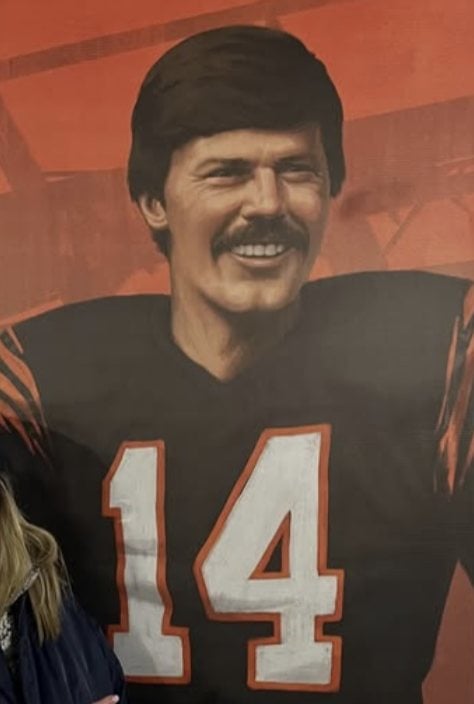
Ken Anderson, a star quarterback from Batavia, Ill. who played at Augustana College in Rock Island, spent sixteen years with the Bengals and played in a Super Bowl. Anderson won the league’s Most Valuable Player award in 1981.
Linebacker London Fletcher (John Carroll) started 215 consecutive NFL games and won a Super Bowl with St. Louis in 1999. He retired in 2013 after sixteen years with four teams. Another D-III linebacker, Jerrell Freeman (Mary Hardin-Baylor), led three teams in tackles; the Colts in both 2012 and 2013, and the Bears in 2016.
Receiver Bill Schroeder (Wisconsin-LaCrosse) played in Green Bay from 1997-2001, part of an eight-year NFL career. He tied for the Packers’ team lead in receptions in 1999, and finished with 1,051 receiving yards on the year. Schroeder led the team in both punt returns and kick returns as a rookie in 1997, when he played in the Super Bowl.
There was also the flamboyant Billy “White Shoes” Johnson (Widener), an NFL star for fourteen years between 1974-88 as a receiver and kick returner in Houston, Atlanta, and Washington. A three-time Pro Bowl pick, Johnson earned a spot on both the NFL’s 75th Anniversary and 100th Anniversary All-Time Teams.
Coleman points to some of the recent successes of Division III players and notes that more teams are taking the chance. “There’s been an uptick in recent years in the number of players who are given the opportunity,” he said. “And in many cases, they have made the most of that opportunity.”
Tom Emery of Carlinville voted on the Melberger Award panel, presented to the outstanding football player in Division III, for seven years, and on the USA III Football panel for six years. He may be reached at 217-710-8392 or ilcivilwar@yahoo.com.