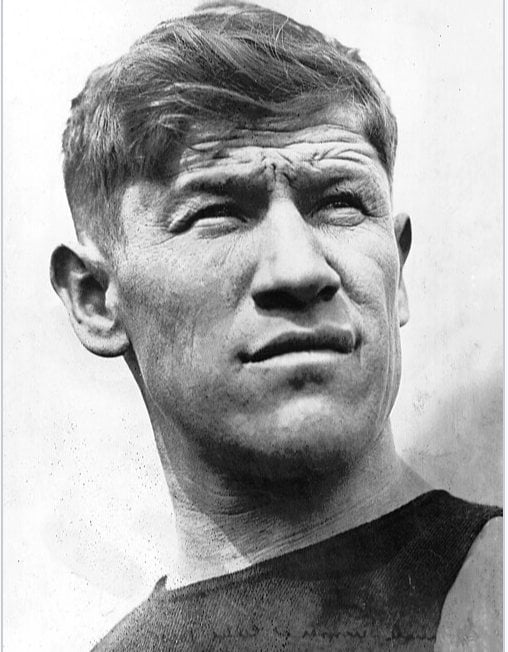
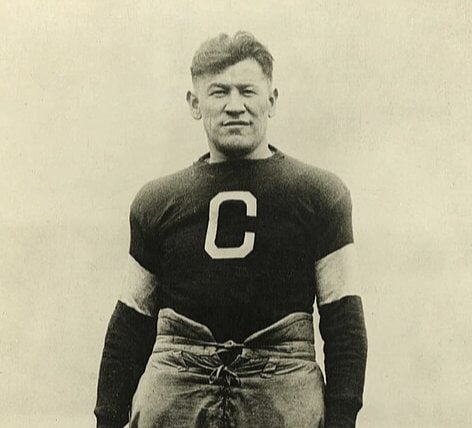
Jim Thorpe helped turn a college football upset into a defining moment in his rise to national fame on Nov. 11, 1911. Leading Carlisle Indian Industrial School against Harvard, Thorpe kicked four field goals as Carlisle defeated the Crimson 18-15. The victory gave a team of Native American players a prominent triumph over one of college football's established powers and brought wider attention to an athlete whose accomplishments would soon extend to the Olympics.
 For this Nov. 11, 2026, look back, Thorpe's performance begins a history that also includes an extraordinary punting record, a breakthrough rivalry victory, an NFL pass-rushing standard and a college basketball coaching first. These moments show how a single date can connect an emerging star with achievements built over entire careers.
Get The Latest News!
Don't miss our top stories and need-to-know news everyday in your inbox.
Carlisle's victory came under coach Glenn “Pop” Warner, whose team finished the 1911 season 11-1. Thorpe scored all 18 of Carlisle's points against Harvard, making the afternoon more than a showcase for his kicking. Against a prominent opponent, his scoring provided the entire margin between a memorable challenge and a landmark win. The result remains a central part of the story of Carlisle's football success.
Thorpe earned first-team All-America honors in 1911 and 1912. At the 1912 Olympics in Stockholm, he won the pentathlon and decathlon, demonstrating the versatility that had already made him such a difficult football opponent. The Harvard game belonged to the earlier stage of that ascent: Before the Olympic victories, a November afternoon had helped introduce his abilities to a national audience.
On Nov. 11, 1939, Texas Tech and Centenary produced a football record of a very different kind in Shreveport, Louisiana. Their game ended in a 0-0 tie after the teams combined for 77 punts — 39 by Texas Tech and 38 by Centenary. Heavy rain and mud made conventional offense difficult, turning field position and the hope of an opponent's mistake into the game's central concerns.
The details explain why the game became a record-book landmark rather than simply another scoreless tie. Sixty-seven punts came on first down, including 22 consecutive first-down punts during the third and fourth quarters. The teams combined for only 23 rushing yards, and just one of five passes was completed. Texas Tech finished with minus-1 yard of total offense, while Centenary managed 31.
Neither team found a winning score, but together they established the NCAA mark for combined punts in a game. The numbers capture an approach far removed from a typical offensive contest: Instead of using a series of downs to advance, the teams repeatedly chose to kick immediately. A game without a point became memorable for how often possession changed through the air.
On Nov. 11, 1978, Nebraska coach Tom Osborne earned his first victory over Oklahoma when the fourth-ranked Cornhuskers defeated the top-ranked Sooners 17-14 at Memorial Stadium. The significance went beyond a close score. Nebraska had beaten the nation's No. 1 team, and Osborne had finally cleared a major obstacle in one of college football's most important rivalries.
Nebraska recovered six Oklahoma fumbles. The crucial late recovery came when Billy Sims lost the ball near the Nebraska goal line and Jim Pillen recovered at the 3-yard line with 3:27 remaining. It was Sims' second fumble deep in Nebraska territory in as many possessions. Those missed opportunities helped preserve a three-point victory that Oklahoma's offense could not overcome.
The teams met again in the Orange Bowl, where Oklahoma won 31-24. That reversal did not erase Nebraska's November breakthrough, but it added another chapter to the season's rivalry. Their two meetings produced different winners, with Osborne's first victory over the Sooners standing as the defining achievement of the earlier game.
On Nov. 11, 1990, Kansas City Chiefs linebacker Derrick Thomas set an NFL single-game record with seven sacks against Seattle. Yet the Seahawks won 17-16 after quarterback Dave Krieg escaped a potential eighth sack and threw a 25-yard touchdown pass to Paul Skansi on the final play. Thomas' record-setting pressure and Seattle's winning escape became inseparable parts of the same game.
Thomas finished that season with a league-leading 20 sacks, showing that the seven-sack performance was the high point of a sustained pass-rushing campaign. He eventually entered the Pro Football Hall of Fame in the Class of 2009. His November record illustrates an enduring distinction in sports: An exceptional individual achievement does not always produce a team victory.
On Nov. 11, 2017, Duke's Mike Krzyzewski became the first Division I men's basketball coach to win 1,000 games at one school. Duke defeated Utah Valley 99-69 at Cameron Indoor Stadium, with freshman Marvin Bagley III contributing 24 points and 10 rebounds. Krzyzewski had already reached 1,000 career victories in 2015, counting his earlier wins at Army; this milestone belonged entirely to his Duke tenure.
The victory came in Krzyzewski's 38th season at Duke and raised his record there to 1,000-271. Four decades of program building had produced a number no previous Division I men's coach had reached at a single school. Where Thorpe's Harvard performance announced an ascending star, Krzyzewski's November achievement measured the accumulated results of an unusually long and successful coaching career.