
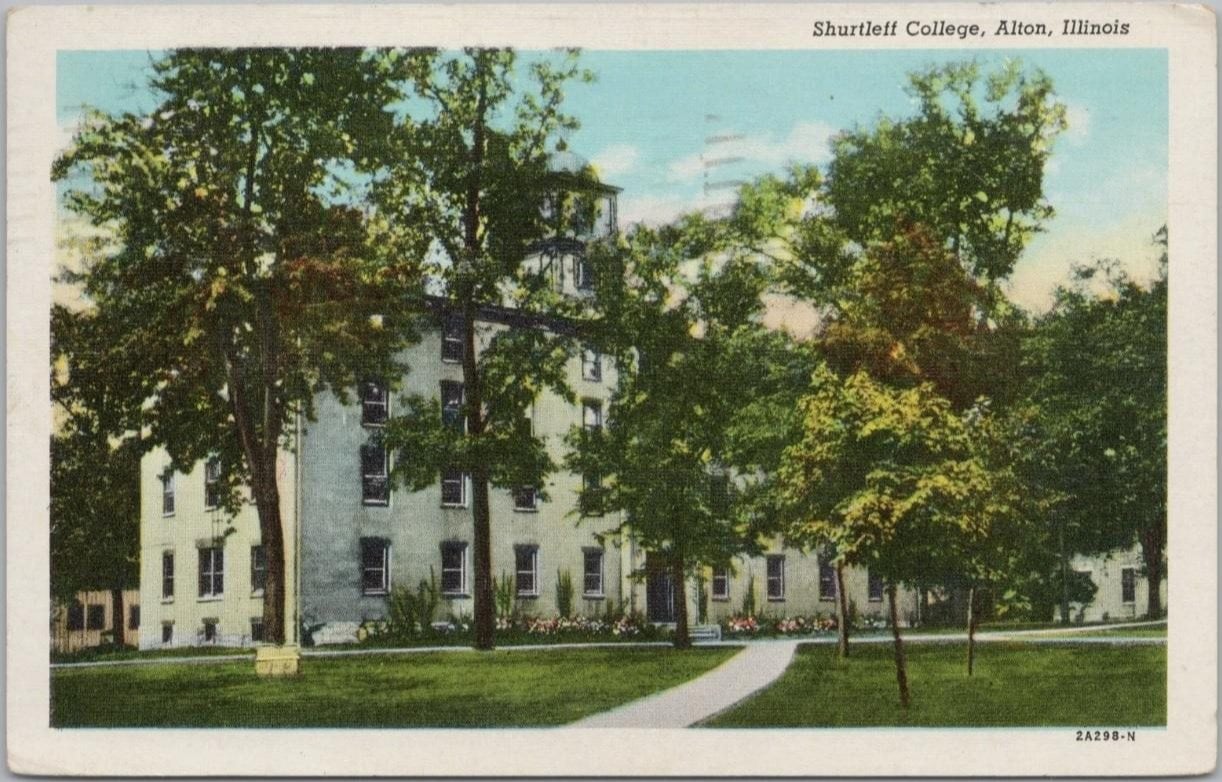
A June 4, 1926 article in the Alton Evening Telegraph described Shurtleff College junior Margery Elizabeth Fish’s unanimous victory in an all-college oratory competition, the Atchison Prize in Oratory, held on June 3. Eight women participated in all. A men’s competition, the Haynes Prize, had been held in the past, but this was the first women’s oratorical contest ever held at Shurtleff during the college’s ninety-nine year history.
Get The Latest News!
Don't miss our top stories and need-to-know news everyday in your inbox.
Fish’s oration, titled “One in a Million,” was a “powerful denunciation of the American tendency to uniformity and mass production.” Fish argued for “clear thinking rather than blind acceptance of popular ideas, for open-mindedness rather than intolerance and prejudice.”
Second place prize went to Louise Campbell of Alton, with her oration entitled, “The Next War.” Campbell’s “stirring attack upon militarism” argued that the next war was “inevitable unless we, as a nation and a world, cease talking in terms of war and begin speaking in terms of peace.”
The other participants and their oration titles were Ethel Faulkner with “Patent Medicine,” Helen Jungk with “Ambition and Courage,” Ellen Johnson with “Forever Ride!,” Francelia Gray with “We Got What We Wanted,” Frances Hartman with “The Death Penalty,” and Marie Cristoe with “Mother.” Monticello Seminary English professor Mrs. Mabel E. Stewart, Philip Enzinger, Jr., of the English department at Alton High School, and local attorney Gilson Brown served as the competition judges.
The competition was made possible by Rev. Robert H. Atchison, Ph.D., rector of St. Paul’s Episcopal Church, who generously volunteered to duplicate the Haynes prize for men with one of equal value for a women’s contest. The winner received $25 and the student placing second received $15. According to an Alton Evening Telegraph article on March 1, 1926, before entering the ministry, Dr. Atchison served as dean of the school of oratory at Highland Park College in Des Moines, Iowa. “In that capacity and also in his position as professor of rhetoric and coach of debating, he developed a keen interest in the art of public address.”
As reported by the June 4, 1926 article, “the contest, as a whole, was superior to the men’s contest recently held, according to several in the audience who heard both.”
Lacy’s note: Margery Fish graduated (with honors) with a bachelor of science in mathematics in 1927 from Shurtleff and won a scholarship to University of Illinois graduate school. The February 9, 1927 Alton Evening Telegraph article that announced the scholarship award, which was considered “the highest scholastic honor in the institution” and was open to both male and female students, described her accomplishments and mentioned that she was “endowed with both exceptional ability and a pleasing personality." She married Herbert LeRoy White in 1928 and they had two children, Margery Ann and Herbert Edmund. I looked forward to learning more about her life, but was devastated to learn that she died in 1936, at age 32. Her death certificate lists typhoid fever as the cause of death, with childbirth as a contributing factor.
Sources
"Adams, Illinois, United States records," images, FamilySearch (https://www.familysearch.org/ark:/61903/3:1:3QSQ-G9KB-BN7N?view=explore : Jun 4, 2026), image 264 of 437; Illinois. Public Board of Health. Archives. Image Group Number: 004008421
“Hillsboro Girl Wins in Oration at Shurtleff.” Alton Evening Telegraph (Alton, IL), June 4, 1926.
“Margery Fish Chosen by Shurtleff Faculty For Illinois U. Scholarship.” Alton Evening Telegraph (Alton, IL), February 9, 1927.
“Miss Margery Fish to Wed.” Alton Evening Telegraph (Alton, IL), April 6, 1928.
“WHITE, Mrs. Margery Elizabeth Fish.” The Decatur Daily Review (Decatur, Illinois), August 27, 1936.
“Women’s Oratorical Contest at Shurtleff.” Alton Evening Telegraph (Alton, IL), March 1, 1926.
More like this: